Tips and Tricks: Old Norwegian Cast On

Recently, I’ve been teaching my friend Susie to knit.  She’s a great student, in large part because she’s knit before, not to mention she crochets already (including teeny tiny crocheted bracelets made with quilting thread and #11 seed beads).  As I do with most new knitters, I first taught her the knitted-on cast on, because it uses the knit stitch.  This means the new knitter doesn’t have to learn some bizarro two-strand loopy thing in order to have a nice, firm cast-on row. (I never teach the backwards-loop cast on as a first cast on, because new knitters invariably stretch it out and get very discouraged.)

Susie, having finished her first project (legwarmers for her little girl), wanted to learn a stretchier cast on for the second pair.  Enter the Old Norwegian Long Tail Cast On, aka the Twisted German Cast On!  (The latter name always makes me think the Germans are kinky… ) I showed Susie how to do it, and made up a little set of words to say while doing it.  She said it made sense to her, and wished there were a video … so without further ado, this video is for you Susie!

Ravelry Monday: Hats, Hats, Hats

Happy Monday! Time to look back at the previous week’s recently added knitting patterns on Ravelry and pick a few favorites.

First Pick: Quinny, by Julie Hahn (FREE! at Gourmet Knits)

Ravelry has been all a-buzz since the episode of Glee where Quinn wears this cute knit hat:

A couple versions of the hat have been released on Rav, but this is the one I like the best. The designer captured the look and shape of the original, including a bang-up job on the yarn button. I predict cute little pixie hats covering the nation’s heads (well, at least the Gleek heads), especially since this pattern uses bulky yarn and should knit up exceptionally fast.

Second Pick: Toasty Bean, by Chelsea Berkompas ($4.99)

I love knitting patterns that work with colorful yarn, mostly because a love colorful yarn and always want more.  This hat has a nice shape and lots of cool details — tassles, buttons, braids, etc.  It also has a very, very cute baby model :).

Third Pick: Inga Snoflinga Hat, by Johanne Landin ($5.00)

What a purty colorwork hat — cleverly placed snowflakes of different sizes and designs on a muted variegated background, yum! It looks like the pattern isn’t available quite yet, but it is a new listing, so with luck it will be up soon.

New Pattern Release: Photog Mitts

Introducing my latest pattern: the Photog Mitts! This pattern for palmless, fingerless mitts in squishable Happy Feet DK is all about maximizing warmth while leaving the hand free for work.  Great for photographers, sailors, and anyone who wants to keep their hands both warm and unencumbered.

1203 photog mitts

1204 photog mitts

Pattern: Photog Mitts

Designer: Rachel Henry (that’s me!)

Available for $3.50 at Ravelry

Yarn: Plymouth Yarn Happy Feet DK

Inspiration: I designed these for my friend Donna (of Donna Kelliher Photography) — she specializes in photographing dog sporting events, which means she is outside in all kinds of weather. Handling a camera with full mittens or gloves on is dicey at best, and regular fingerless mitts cover the palm in fabric, which bunches up and makes holding the camera difficult.

Design/Skills Needed: The cuff is worked in the round, starting with a simple scalloped edge that comes to a point and continues in a subtle line of slipped stitches all the way up the wrist and hand. Stitches are cast off at the base of the palm, and the remainder of the mitt is worked flat with slip-stitch edges that hug the palm. A thumb gusset provides superior fit. The top is finished with i-cord edging that runs around the pinky and pointer fingers to hold the mitt in place – the thumb is also finished with i-cord edging.

Yarn: Suitable for the most colorful hand-painted yarn, but stylish with subdued colors too, these functional yet charming mitts are quick to knit and fun to wear.

I would be delighted to answer any questions or help any knitters working on this project.

Book Review: Knit Your Own Dog by Sally Muir & Joanna Osborne

This book caught my eye a few weeks ago, when patterns and projects from the UK edition started popping up on Ravelry. A quick perusal revealed that there was in fact a Border Collie pattern included in the book, and it was charming! I pre-ordered the US edition on Amazon and was delighted when it arrived this week.

Of course, I immediately cast on for my very own Border Collie, using left-over Palette (a heathered dark brown, and cream) and Size 1 Addi Turbos.  In one evening, I was able to finish all four legs, both halves of the body, and begin on the neck and head.  As you can surmise from this list of parts, the Border Collie (and is worked in a series of bitty parts, worked flat. Some intarsia work creates the classic Border Collie markings — as with all amigurumi knitting, it is vital to knit tightly to ensure the finished toy keeps it shape and does not reveal too much of the stuffing.

The listing for this book on Ravelry is incomplete.  For this reason, I’ll provide a comprehensive list of the breed patterns here.

Hounds: Afghan Hound, Whippet, Dachshund, Basset Hound

Terriers: Wire-haired Fox Terrier, Jack Russell, Scottish Terrier, West Highland Terrier, English Bull Terrier

Sporting: Cocker Spaniel, Red Setter, Labrador, Portuguese Water Dog

Non-sporting: Dalmatian, Poodle, Miniature Schnauzer, French Bulldog, English Bulldog, Pug

Working: Rough Collie, Border Collie, German Shepherd, Old English Sheepdog, Corgi, Siberian Husky

I’m especially impressed with the clever shaping at the beginning of each leg to create a proper foot.  I’ve only just begun the head, and already I can tell some thoughtful shaping will make a very pretty head there as well. The selection of breeds is fantastic — a smattering from across the spectrum, including many of my personal favorites. The details that make each breed unique are fantastic: the Afghan’s flowing coat, the Basset’s floppy garter-stitch ears and jowls, the Scotty’s fringe and beard, the upright stance of the Poodle, the smooshed face of the Bulldog, the Collie’s exuberant mane … all will ring true to lovers of each breed. The authors provide helpful tips in selecting yarns that will best create the coat of each breed (boucle for the Porty! genious!), in addition to all the detailed shaping and design.

I do have a few minor quibbles.  Because the directions are written line-by-line, the knitter must follow along and trust that the color changes and shaping will lead them to the finished product.  It reminds me a bit of the first time I made a Baby Surprise Jacket — take a deep breath, dive in, be precise in following directions, and it will all turn out all right in the end.  That said, I find myself wanting to make charts, especially with the color changes, so I can more easily adapt the pattern to match my own dog. It would have been lovely to have a bit more explanation about the purpose of each shaping section, and charts to make customization easier.
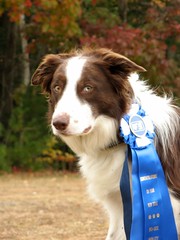
1151 Gromit CL3After I make a toy Gromit, I’ll probably make toy versions of some of my agility-friends’ dogs.  I’m thinking a Scottie or two would be well-received, and I think I could adapt the Dalmatian pattern to make a big brown-spotted Pointer mix. After that … we shall see.

Ravelry Monday: Shoggoth, Reversible Tiara Hat, Sho-sho

Happy Monday! Time to look back at the previous week’s recently added knitting patterns on Ravelry and pick a few favorites.

First pick: “Shoggoth” by Lee Meredith (part of an e-book, sold at $5.00)

It was a terrible, indescribable thing vaster than any subway train — a shapeless congerie of protoplasmic bubbles, faintly self-luminous, and with myriads of temporary eyes forming and un-forming as pustules of greenish light all over the tunnel-filling front that bore down upon us, crushing the frantic penguins and slithering over the glistening floor that it and its kind had swept so evilly free of all litter… — “At The Mountains of Madness” (H. P. Lovecraft)

I’ve played enough Arkham Horror to know that a Shoggoth isn’t something you want to meet ever, let alone have in your home — but this mini Shoggoth-pincushion is welcome to take up residence on my knitting table.  The designer captures the fluid asymmetry this particular monster should possess, while simultaneously making it cute.  A great first amigurumi project — you  can mess up a bit, and it would still be right! — and a perfect home for those odd buttons I’ve been saving up.

Second pick: “Reversible Tiara Hat” by Kristina Schling (part of a book, sold at $15.00)

This pattern makes clever use of the reversible nature of double-knitting to make a charming and warm beanie worthy of a princess. Although I love the popsicle colors of the sample hat, I think I might have to use golden yellow and princess pink — don’t you think?

Third pick: “Sho-sho” by Nokko Asano (FREE!)

I’m intrigued by this drapey shrug… I’ve been wanting to make one of these “rectangle with sleeves items for a while, because they look so comfy and wonderful.  I have put it off though, because it involves knitting a giant rectangle (just the kind of knitting I abhore).  This pattern, with large needles and a silk/linen yarn, may be enough to put me over the edge.  There isn’t any sizing on the pattern, which means I’d have to guess how much bigger to make it for myself.  (I’m not really “tiny Japanese” shape, more like “European peasant stock.”)  Still, it’s pretty and should knit up reasonably quickly. Pretty!

FO Friday: Queen Anne Mystery Socks

1481 Family Jewels Mystery Socks

Yay, my socks are done! I have really enjoyed this mystery sock-a-long sponsored by the Knitters Brewing Company.  I talked about yarn selection and knitting style already, so instead of repeating myself, I will instead say how much I have been looking forward to having these socks done and on my feet. So pretty! I can hardly stand it. Easily my favorite detail: the heart cuff.  How charming is this?

1484 Family Jewels Mystery Socks (heart cuff)

Pattern: Mystery Socks III: the Family Jewels

Designer: Wendy Gaal

Available: free! on ravelry (kits are available with matching yarn and beads)

Yarn: Stroll Tonal in Queen Anne

1483 Family Jewels Mystery Socks (bead motif)

This pattern has a number of “new to me” features.  One of the big reasons I signed on was the opportunity to try a big bead on a sock.  When the time came, I ran off to Legacy Beads to find a 15mm-ish flat bead that worked with my yarn — no clashing colors, not so matchy as to fade into the yarn, but not too contrasty either. I settled on a “twist” Swarovski crystal bead in “Golden Shadow.”  My mad beading friend inspected the bead and determined that it had an “AB” finish on the back, but not the front, which helped it keep it’s own color while still reflecting some of the yarn color.  This makes sense to me — I had tried a clear crystal version, and it completely disappeared into the yarn.

1485 Family Jewels Mystery Socks (fleegle heel)

Another cool new-to-me thing is the Fleegle Heel. I didn’t know this was in the pattern when I signed on, so it’s pure bonus! I found it easy to do, and a nice fit.  I enjoyed it way more than a toe-up heel flap (those joins! ugh!), and it fits way better than a traditional short-row heel.  You can see a small err in my photo — the racing stripes on the gusset were supposed to blend into the leg, but I failed my “read the directions” roll and started the racing stripes one stitch too soon.  Oh well — only the designer and the 200 other people in the knit-a-long will even notice.

In general I found the pattern to be extremely well-written and mistake-free.  I prefer a charted pattern to words, but I understand the designer’s desire to “surprise” — and how a chart could potentially ruin the surprise.  I believe a complete version of the pattern will be released with full charts and so on, so chart lovers need not despair (or resort to home charting, as I did).  All unusual techniques were well-explained and/or had links to good videos.  Great fun, great community of KAL-ers!

1482 Family Jewels Mystery Socks (front and back)

Tips and Tricks: Steam-blocking a Ruffle

The Problem: Ruffled Edges

Recently I was finishing up a sample knit for a girl’s tank top.  I designed the shoulder straps with a ruffled edging … which is a little challenging to block, as it turns out.  Today I’ll share the method I used to get the ruffle to be “pretty” without flattening it into submission. Here’s a quick “before and after” shot, using both straps.  The lower strap hasn’t been blocked at all, while the upper strap has — observe the nice square ends of the blocked strap, and the pleasing curves of the blocked ruffle:

1465 ruffled strap (steam-blocked and un-blocked)

Step #1: Pin it out

You didn’t think you’d be able to get away without pins, did you? I used pins to hold the strap squarely on the proper measurements (in this case, 1″ x 7″).  Leave the ruffled edge un-pinned.  The strap is NOT washed beforehand — it’s dry.  Angle the pins away from the piece, to make it easier to get the iron in on the next step.  I’m using a sewer’s ironing board, with padding over a cardboard base (at least I think that’s what it is).

1455 ruffled strap (pinned)

Step #2: Steam it up

With a full iron on steam, hover over the pinned piece, flooding the entire strap with heat and moisture.  Move the iron slowly back and forth over the strap, without touching it. 

1457 ruffled strap (steaming)

Note the space between the iron and the knitting! Don’t let the iron touch the knitting.

1459 ruffled strap (iron clearance)

Step #3: Mold the ruffle

After steaming, the ruffled edge opens up considerably.  It’s no longer curled it a tight roll.  However, it still isn’t exactly right.

1460 ruffled strap (steamed)

Use your fingers to pinch the ruffled edge, molding it into a sinuous curve while it is warm and moist from the steaming.

1462 ruffled strap (shape ruffles)

Step #4: Cool it

Allow the strap to cool completely.  Keep the pins in place and do not disturb the ruffle.  Cooling will “set” the curve you’ve made.  Unsatisfied?  Fire up the iron and give it another go.

1463 ruffled strap (cooled)

Ravelry Monday: DeeVine, Jaiozi (Dumplings), Lobster Beanie Hat

Happy Monday! Time to look back at the previous week’s recently added knitting patterns on Ravelry and pick a few favorites.

First pick: “DeeVine” by DeeTara ($3.99)

This hat is pure loveliness — beautiful swoopy leaves in an overlapping pattern that pleases me.  Slouchy hats keep me warm without crushing my hair, which puts them high on my “to-knit” list.

Second Pick: “Jaiozi (Dumplings)” by Dale Hwang (FREE!)

Mmmmmm, Peking Ravioli! Pan-fried, please.  Cannot resist this knitted dumpling pattern.

Third Pick: “Lobster Beanie Hat” by Christine Grant ($4.25)

Since I am a New-Englander, I had to include this hat on my Ravelry Monday list.  What’s not to love about a bright red beanie with a lobster on top?

New Pattern Release: Aviator Scarf

Introducing my latest pattern: the Aviator Scarf!  This lacy scarf pattern can be worked in lace weight or fingering weight yarn, with two very different finished products.  The lace-weight version produces an ethereal scrumptious scarf that floats around your neck.  The fingering-weight version is sturdier and more forthright (and, it should be said, a much faster knit).

011511b 021011511b 028

Pattern: Aviator Scarf

Designer: Rachel Henry (that’s me!)

Available: for $1.99 at Knit Picks

Yarn: Knit Picks Alpaca Cloud (for the lace version) or Knit Picks Gloss Sock (for the fingering version)

011511b 032

Inspiration: I wanted to make something lacy that looked impressive but was do-able for beginner lace knitters. Size, repeating pattern, and only a few lace stitches make this scarf deceptively simple. Early in the design process I found myself thinking of real-life aviators and steampunk air pirates while working on the pattern — this scarf is for the girl pilot in all of us :).

Design/Skills Needed: Scarf is worked in two halves, starting from the ends and grafted together in the middle. Wrong-side rows are purled to speed knitting, and narrow garter-stitch borders help the scarf lie flat. The pattern looks tricky, but is achieved with only k, p, k2tog, YO, ssk, and a right-leaning centered double decrease.

I would be delighted to answer any questions or help any knitters working on this project.

Yarn Review: Knit Picks Chroma Fingering

This week I’ve been knitting with Knit Picks Chroma Fingering, their brand-spanking-new, slow-color-changing yarn (also available in worsted weight). As far as I know, this was a top-secret project, and Knit Picks kept it quiet for over a year until it arrived just before Christmas with many fireworks and much ado, at least on the Ravelry boards.  There are already over 100 projects listed in Ravelry using Chroma, which is pretty amazing considering it was released just over a month ago.  If you’re curious about the process of creating a brand-new yarn line, check out Knit Picks Podcast #151.

I’m working on a new pattern for Knit Picks IDP.  I’d worked up a sample swatch in Felici Sport in the now-unavailable “Picnic” colorway, and submitted it to a magazine … after the usual epic wait for a decision (knitting magazines have a Very Long Time Horizon), they decided not to use it.  Ever the optimist, I re-did the submission and turned it right around to Knit Picks. It is incredibly reinforcing to submit to KP, because they decide so quickly! I heard back that the proposal was accepted within a week. Of course, nothing is final until they have the sample and finished pattern in hand, but they did agree to give me yarn support.  I was sad to hear that Felici wasn’t an option, but delighted when they agreed to send me some of the new Chroma! Yay!

Yarn: Knit Picks Chroma Fingering

Fiber: 70% wool, 30% nylon

Price: $8.99 for each 100-gram ball (396 yards)

Care: hand-wash

Colorway: U-Pick

1404 Chroma (glamour)

First Impressions:gorgeous, soft, fluffy, awesome

I pulled it out of the envelope and ooohed and ahhed out loud.  The balls are squishy round things that show all the gradual color changes. I cast on the same day, starting work on the sample for my pattern.  It begins with a simple braided cable on a garter-stitch background.  This strip is narrow (23 sts), so each color lasts several repeats.  When the cable was long enough, I joined it in a circle and picked up stitches all the way around, just over 100.  At this circumference, each color runs for about an inch. I was a little afraid that the repeats would be too short and make the fabric stripey, but instead I got exactly what I hoped for: slow, beautiful, easy gradations from one color to the next.

1403 Chroma Top

The yarn is spun as a single, and is similar to Malabrigo in texture (though Malabrigo, the king of softness, is perhaps a smidge softer than Chroma). Like every single-spun yarn I’ve ever used, it can be a bit cantankerous: it is splitty, dropped stitches are tricky to retrieve intact, and I had to use a cable needle on my big 5×5 cable crosses. However, once knit, the fabric is soft and smooth, with just a bit of variation (see the slightly bigger stitches in only one row? the yarn was a bit fatter there).

1405 Chroma (stockinette)

The finished fabric has a slight halo, even without being washed and blocked.  I expected it will bloom significantly after washing, and I suppose it would happily felt if mistreated. Even with the softness and halo, I found it had great stitch definition.

1406 Chroma (halo)

Now it’s obvious to me that Chroma is meant to compete with the biggies in slow-color-changing yarn: Noro, Mochi, and the like. I’ve knit one thing, once, with Noro Silk Garden … let us just say, I encountered every problem that Noro haters complain about: knots that interrupted the color changes, harsh yarn that hurt my hands, grass and other prickly junk in the yarn, yarn that pulled apart with very little provocation, and more. I’ve been sad not to knit with Noro, because I love the colors … I just can’t stand working with the yarn.  I am thoroughly delighted to have Chroma, which is such a pleasure to work with.

Rating: 5 of 5 DPNs