FO Friday: Summer Rain (AMS KAL 2011)

2812 Mystery Shawl

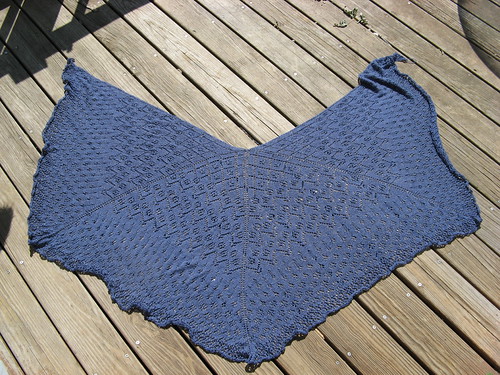
For the third year in a row, I was a happy member of Renee Leverington’s “Anniversary Mystery Shawl” group.  The KAL began in May, but I made the project even bigger by doing four panels (instead of three) and adding beads throughout the shawl.  The last few rows were taking me 1-2 hours each, but the finished project is 100% worth the effort! I love the weight of a beaded shawl, and the click-clack the beads make as the shawl swings.

2813 Mystery Shawl

Project: AMS 2011

Pattern: Summer Rain

Designer: Renee Leverington

Available: $6 at Renee’s shop

Yarn: Jaggerspun Zephyr Wool-Silk in Blueberry — my first time knitting from a cone!

Beads: size 6 in “gunmetal iris”

2811 Mystery Shawl


“Summer Rain” was another creative and flawless pattern, just as I’ve come to expect from Renee.  The pattern called for three triangles, blocked into a half-hexagon.  I decided I wanted more shoulder coverage and added a fourth panel and blocked it as a 2/3-hexagon.  I also went a little crazy with beads!  Near the top beading rows were few and far between, but I systematically increased the amount of beading until it was nearly every row on the final “clue” of this mystery shawl.

Did you know that beads are hard to photograph?

2810 Mystery Shawl


This year four members of my knitting group worked on the mystery shawl. The first person to finish entered her shawl in a local ag fair and won 2nd place!  I’m the second person to finish — two more to go!

2809 Mystery Shawl

I was surprised by how nicely the Zephyr lace yarn stretched out while knitting.  Silly me, I thought it “barely” needed blocking.  Here is a before shot — you can see how dense and crumpled it is compared to the blocked photos above.
2806 Mystery Shawl (unblocked)


Here’s the pinned-out shawl! I used Knit Picks cables (from the interchangeable set) to block the top edges, and I pinned out points along the bottom edges.  The shawl dried super fast — completely done in just one afternoon.

2808 Mystery Shawl (blocking)

Cast-on Monday: a pansy and a wristlet

Last Monday, I didn’t have any new projects to talk about! The horror! I went a whole week without casting on anything new.  How tragic. This week I made up for this lack by casting on TWO new projects, using yarn I bought at the Hub Mills sticker sale.

Here’s my start of Panzee, in CEY Cotton Classic. I’ve never actually made a washcloth before, and I just love the Pansy Cloth pattern (by designer Theresa L. Jones).

2772 panzeeI

I also cast on for my Hellebores Wristlets, in CEY Silky Alpaca Lace. As far as I can tell, I’ll be able to make the wristlets AND the hat from a single ball of the super-soft very-purple yarn.  This project came about because the designer of Hellebores, Anne Hanson, was chosen for a designer JAL by the 52 in 52 group on ravelry.

2744 Silky Alpaca Lace

2771 wristlets

FO Friday: Shiny Purple Maluka

2692 Maluka

Maluka is the August KAL in the Beginner Lace Knitters group on Ravelry. It was one of my nominations, so I was extra excited to cast on! I rummaged through my stash and found the perfect hank of too-pretty-for-feet sock yarn: a gorgeous purple wool-bamboo blend with a lot of shine and personality.

This shawlette is almost a scarf — very petite! But, quick to work up.  You work the garter border first. The cool 3-over-3 bundle that makes a chain of circles that is very pretty. After the border is complete, you pick up stitches all along the edge, and work the body in a series of short rows to create a graceful crescent shape.

2689 Maluka tip

Project: Shiny Purple Maluka

Pattern: Maluka

Designer: Bea Schmidt

Available: FREE! on Ravelry

Yarn: Three Irish Girls McClellan Fingering

2690 Maluka

I’ve been wearing my Maluka constantly — even with grubby shorts and a T-shirt :). (I never said personal style was my forte!) I love how it drapes.  The designer is German, so it’s not too surprising that the edging chart follows the convention of showing what you actually knit, rather than the right side of the work.  I know there are knitters out there who prefer this style of chart, but I much, much prefer a chart that shows what the right side of the work looks like.  I have no problem understanding “knit on RS, purl on WS” etc.  For my own sanity, I did make up a “right side” version of the Maluka edging chart, which I have made available at Google docs for knitters who think like me.  (You will still need the original pattern to make a Maluka, as this is only the edging chart.)

I modified the pattern just a smidge, nothing major.  I used wrap&turn short rows, rather than the decrease/slip short rows called for.  I found that the decrease was making a big lump in my fabric.  I also wanted to use a little more yarn and have a slightly bigger finished object.  For the neck edge, I decided to use an i-cord bind off, which I extended over the cast-on and bind-off ends of the edging.  I am a bit of an i-cord fanatic! 🙂

In sum: great pattern, love my FO, another great KAL!

2688 Maluka


Test Knitters Needed: Marilla’s Very Practical Shawl

I just finished the sample for a pattern for Knit Picks IDP worked in their GORGEOUS Swish Tonal (Blue Violet colorway).  I need a few intrepid test knitters to help me ferret out any errors or confusing bits.  If you’re up for the task, send me a message!

Marilla’s Very Practical Shawl

2644 Marilla shawl 2639 Marilla shawl

Design details: The shawl begins with the bottom edging, worked from right tip to left tip, with a short-row corner halfway through.  Stitches are picked up along this bottom edge, leaving 8 repeats at both tips to form the ties.  The body is worked from the bottom edge, with decreases to form the spine and top edge. After the body is completed, the neck edging is worked from right tip to left tip and joined to the body as you go.

Craft(s): knitting
Number of Testers: 2 for charts, 2 for written directions
Approximate Hours to Complete: 30
Deadline: August 26th, 2011
Tools needed: #8 needles, tapestry needle
Material needed: 1100 yards of worsted-weight yarn
Pattern Difficulty: middling — skills needed include basic lace work, picking up stitches, short rows, and joining a lace edging to the body as you go
Formats Available: PDF
Pattern Style: full written directions, charts for some portions

Testing needs: Error checking for charts and written pattern; clarity of directions for construction; confirmation of yardage requirements.


FO Friday: Red Seas

2546 Red Seas Shawl

I brought yarn and needles for a number of new projects on my family vacation over the Fourth of July.  I promised myself that I could cast on ONE new project for every TWO that I finished.  Well, I finished socks and a cowl, so I rummaged through my knitting bag (and box, and 2nd bag) and brought out a skein of Stroll Tonal in “Gypsy,” along with the pattern I’d matched it with … at the same time, elsewhere in knitting-land, the Beginner Lace Knitters group on Ravelry chose a tempting pattern for their July Knit-A-Long. I looked at the yarn and needles I had in hand, and realized they were perfect for my very own Rough Seas. Out the window with my original plan! I cast on with glee, and given the results … I’m not a bit sorry. (Shawl is smaller than it appears here, modeled by my almost-9 son.)

2547 Red Seas Shawl

Project: Red Seas

Pattern: Rough Seas

Designer: Preita Salyer

Available: FREE! on Ravelry

Yarn: Knit Picks Stroll Tonal

Although I’m in love with my finished shawl — I even wore it while I waited in line for 3 hours for a signing of the new “Game of Thrones” book! outside, in July! — I have to say, with all respect, the pattern as it is currently available is almost unusable.  It is rife with errors, omissions, and confusing instructions.  Were it not for great notes on existing projects on Ravelry, it would have been nearly impossible to follow. Even with those notes, I still had trouble sorting out which parts of the pattern were right and which were wrong.  The lace charts included in the pattern were non-standard and had errors and conflicting design (right vs. left half of shawl). I ended up making fresh charts in excel to show how I decided to do the pattern … I made enough changes that you could argue that my shawl isn’t really a “rough seas” at all.

2551 Red Seas (greenery)

Corrections I used for my shawl:

  • Inserted a WS row between Rows 7 & 8
  • Repeated Rows 1 thru 10, eleven times total — 231 sts altogether, 113 on each “side” (not including 2 edge sts and center spine st).
  • I saw no reason to use the increase rows as written, since I already had the right # of sts.

Lace charts:

  • I used the ssk/k2tog orientation from the “right side of shawl” chart (they are reversed on the “left side” chart).
  • I opted for a s2kp rather than a sk2p, because I like the more centered look with a vertical line.
  • I extended the lace pattern into the corners to avoid a big chunk of un-patterned stockinette.
  • I added an increasing section on the edge (to use the edging YOs).
  • I used my corrected/altered “right side” chart for both sides, thus avoiding the problems with the “left side” chart, including the pattern repeat box being one stitch too large, and also the missing column of ssk’s near the center increases.
  • I decided to do three (rather than two) repeats of the edging to better balance the shawl (and use up more of my skein).
  • I finished with one additional repeat of row #1 to “finish” the points on the pattern.
  • I used a decorative crochet finish rather than just binding off, for prettiness and to avert curling on the FO.

Crochet edge:

  • In the “points” I (DC, ch5, DC) in the stitch below the point.
  • Between points, I (DC, ch3), with the DC going through TWO stitches…
  • … except for the THREE sts at the point of the lozenges, where I (DC, ch3) with the DC going through THREE sts (so it would be centered.

I’ve made my version of the rough seas charts available on Google docs.

2552 Red Seas (point)

I thought this shawl is a great example of how much blocking can change a knitted object.  Here you see the unblocked shawl: you can barely see the eyelet rows in the body, and the lace and crochet edging looks lumpy and curled. You can see that it is about six boards across the wingspan.

2531 red seas (unblocked)

Here is a photo of the shawl while being blocked: you can see that I’ve straightened the top edge, and pulled out the points severely. I kept the triangle shape rather than morphing it into a more curved shape.

2534 rough seas (blocking)

Here is the fully blocked and dried shawl — nearly 10 boards across! The yarn (superwash sock yarn) has held the blocking better than it has any right to. The points especially have stayed crisp and dramatic.  Yay!

2549 Red Seas

Cast-On Monday

While on vacation I finished several projects, which meant I could cast on new projects! I brought several yarn+needle combinations with me, including leftover Swish DK in Hollyberry and Marble Heather that my youngest son picked out for his requested cowl.  He wanted it to be “half red and half grey,” and I wanted it to be cabled (so it would stand up better). I conjured up a way to knit it without seaming ….  and it was so fast and easy I finished it while on vacation! I’ll write up a pattern and test knit it later, but here is the prototype of my Two-Color Knit-Flat In-The-Round Cabled Cowl:

2524 two-color cowl

I also had with me yarn and needles destined to be Bertha’s Mad, Mysterious Mobius, but then the Beginning Lace Knitters chose Rough Seas as there July KAL, and I couldn’t resist!  My Stroll Tonal in Gypsy was too perfect for words, so I gave up the mobius (at least for now) and cast on my Red Seas Shawl:

2505 Red Seas

As of today, I’ve finished the body and done three repeats of the lace edging (I’m weighting my yarn after each repeat — I’ll make it as big as I can). I have to say, there are a LOT of problems with this pattern — confusing parts, mis-count stitches, missing rows, poorly-formatted charts with several different types of errors — BUT, the finished shawl is so pretty, it’s worth the effort to muddle through the pattern + helpful notes to figure out how to get it done.

FO Friday: Zino Square Lace Shawl

1119 Zino

This week I’m featuring another of my pattern sample projects for Plymouth Yarns: a square lace shawl made from Zino, a long-repeat color-changing yarn. The shawl is worked in the round from the center out, with a cool open/solid lace pattern that really suits the yarn. I especially like the border, which shows the long color repeats well.  (My quickie photo (below) is shown before blocking.)

1196 lace for Plymouth Yarns (unblocked)

Project: Zino Lace Sample Knit

Pattern: Square Lace Shawl

Designer: Plymouth Yarn Design Stuido

Available: ask your LYS

Yarn: Zino

Lo, the gorgeous blocked shawl:

002832

This was by far the largest sample I’d knit for PY — it took a lot longer than a pair of armwarmers or a little vest. It was also more complex–this was the project where I really learned how to work with the designer at PY, because I ran into problems/questions and we went back and forth a couple times before we settled on the right solution.  Ultimately it’s her design, so naturally I want to serve that … but my job is to make sure the pattern adheres to her vision as I knit, so when I find things that don’t work, I stop and ask for direction. Sometimes, I even have something useful to contribute.

New Pattern Release: Kudzu Shawlette

Introducing my latest pattern: the Kudzu Shawlette! This dramatic lacy shawlette, worked in soft, luminescent Cotton Bam Boo, is a versatile accessory for all seasons.  This pattern was designed especially for Classic Elite Yarn‘s free weekly web-letter.

shawl1

shawldetail1

Pattern: Cotton Bam Boo Kudzu Shawlette

Designer: Rachel Henry (that’s me!)

Available: free at Classic Elite!

Yarn: Classic Elite Cotton Bam Boo

shawl4

Inspiration: In the southern United States, Kudzu flows over the land like waves caught in time. When I lived in Virginia, I loved to watch the daily progress this “weed” made, overtaking trees and buildings alike. I tried to capture the impression of motion in this shawlette, using lace patterns that transition organically from one to the next.

shawldetail2

The top edge begins with a twisted rib that expands into the first round of leaves.  The second round of leaves, slightly larger, develops from a column of twisted knit stitches left-over from the rib. The third and final round of leaves, larger still, expands to take over the lattice at the bottom edge.

shawl3

This lacy shawlette can be worn over the shoulders with a fancy accent button or shawl pin to hold it in place. The full length version can also be wrapped twice around the neck for a more casual look. The midi length is just long enough to go once around the shoulders. 

shawl5

Design/Skills Needed: Kudzu is worked flat from the top down.  Because there are so many stitches (especially in the full-length version), I highly recommend using circular needles. In addition to the slightly unusual wrapped stitch in the twisted rib pattern, the pattern also includes more common lace stitches (yarnovers, decreases, double decreases), and knitting and purling through the back loop. The pattern is fully charted, but also has complete written directions. Ambitious beginning knitters will find this a challenging but achievable introduction to lace knitting; intermediate and experienced lace knitters should enjoy the ever-changing pattern.

I would be delighted to answer any questions or help any knitters working on this project.

shawl2

I thought it might be interesting for knitters to see a little bit of the design process for this pattern. This is my final sketch for Kudzu, made after swatching, but before the sample was knit. Close observers will notice how much longer the finished sample is, compared to the sketch. In fact, the Cotton Bam Boo stretched much more than I anticipated, even after careful swatching.  The resulting sample was significantly longer than I had anticipated, but I found myself really liking the length.  I showed it to a fashionable younger friend of mine, as well as several different knitting friends, and they all gave it a bit thumbs-up.  I included the “midi” length in the pattern, which is closer to my sketched version.

image_25_1_2011-1(rev 1)

I’m also sharing scans of some of my notes and charts from false starts and final versions. I don’t have much commentary on these — just sharing!

image_30_5_2011(rev 0)image_29_5_2011-3(rev 0)

image_29_5_2011(rev 0)image_29_5_2011-1(rev 0)image_29_5_2011-2(rev 0)

Ravelry Monday: Catkin, Lavandula, Spring Cloud

First Pick: Catkin, by Carina Spencer ($7.00)

I love the clever construction and colorwork on this cozy shawl.  The first version has bold autumnal colors that really pop.  The second version shows how a subtle color choice can make a very different finished object — I love both.  The colorwork at the hem is done with slipped stitches, so it is much more accessible to knitters who fear Fair Isle colorwork.

Second Pick: Lavandula, by Mia Rinde ($6.00)

There will always be more lace shawls out there that I want to knit, and this one just got bumped to the top of my “to do” list.  I love the wide swaths of stocikinette (great for showing off some multi-colored yarn!), but what really got me is the 4-lobed hem edge — love it!

Third Pick: Spring Cloud, by Sachiko Uemura (FREE!)

For my last pick this Monday, I bring you this simple, elegant use of two yarns.  The body is worked with a fingering-weight yarn held together with a lace-weight mohair yarn, and the feather-light cowl is worked with the lace yarn alone.  It floats above the top like a separate cowl, but it matches and drapes perfectly.