New Pattern Release: Bifurcate Kumara Cowl

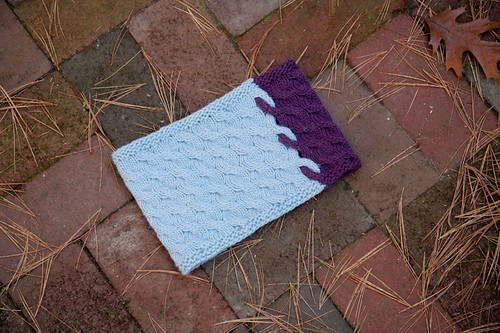
I’m pleased to announce the release of my latest pattern: a two-color, knit-flat, in-the-round, cabled cowl.  Bifurcate Kumara Cowl was featured in Issue 218 of Classic Elite’s Webletter (if you aren’t already a subscriber, sign up! free patterns, once a week! can’t beat that 🙂 ).

4613

Here’s what CEY had to say about Bifurcate:

This two color cowl is a show-stopper, and its construction is incredibly clever. How’s this for a brain-teaser…the entire cowl is knit back and forth, NOT in the round. Curious? This ingenious design comes from Rachel Henry, the designer who brought us one of our most popular Web-Letters to date, the Cotton Bam Boo Kudzu Shawlette.

There is no cozier yarn than Kumara, with its soft, lofty blend of extrafine Merino and baby camel hair. The camel hair is undyed, resulting in a muted effect that performs in perfect harmony with the sophisticated palette of 23 colors. Baby camel, a fiber with a softness rivaling cashmere, is expensive on its own, but you’ll find it in this decadent blend at an affordable price. This yarn is pure luxury!
4635

Pattern: Bifurcate Kumara Cowl

DesignerRachel Henry (that’s me!)

Available: Free! from Classic Elite’s Web-letter (Issue 218)

Yarn: CEY Kumara in Thai Purple and Royce Mountain

4619

4623

Design/Skills Needed: This cowl is “knit flat” in the sense that it is worked back-and-forth, with RS and WS rows.  When the colors cross, the RS and WS rows overlap a little bit — it’s easier to do than describe!  However, this cowl is also “knit in the round” in the sense that it is worked row-by-row and there is no long vertical seam.  If you can cable and follow directions carefully, you can make this cowl.

2740 Kumara Two-Color Cowl (inside)

Inspiration: My youngest son saw me working on a lacy cowl for myself, and asked if I would make him a neckwarmer too. I showed him my stash, and he chose a dark red and light grey and instructed me to make it “half one color and half the other, like this,” holding his hands up to his own neck. This request was the initial inspiration for this two-color, knit-flat, in-the-round, cabled cowl.

I knew I wanted to use simple cables, with no separation, to make subtle overall pattern that would also give the cowl some vertical structure. Almost right away, I could see in my head how the two halves could meet and twine together using this same cable pattern. I knew I could accomplish this by knitting first one half and then the other, but I wanted to make it all at once – in the round, at least nominally.

The first prototype, now in my son’s coat pocket, looked great. “Bifurcate” is the second generation of this original cowl, and is improved in several small ways. I changed the top and bottom edge to be less flared, and used different yarn and stitch counts to create an adult-sized cowl. I chose soft, luscious Kumara for it’s to-die-for touchability and great stitch definition. When washed and block, the soft halo is lovely.

The original knit-flat, in-the-round, two-color, cabled cowl:

2524 two-color cowl


New Pattern Release: Babylon Shawlette

Introducing my latest pattern: the Babylon Shawlette!

IMG_2889(rev 1)


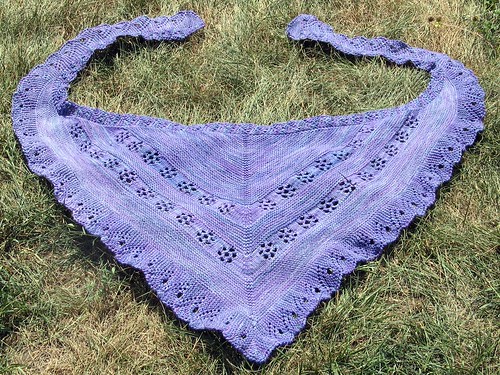
Knit from a single skein of sock yarn, this shawlette started out life destined to be a pair of socks … but the yarn wanted more. In sock form, the colors pooled and flashed in an unacceptably foul manner. No matter what I did, the yarn would not cooperate.


IMG_2893(rev 1)

PatternBabylon Shawlette

DesignerRachel Henry (that’s me!)

Available: $6 on Ravelry

Yarn: Blue Moon Fiber Arts Socks That Rock Lightweight (biggie skein)

6209708300_9fe8ce3225_b(rev 1)

Design/Skills Needed: This sinuous shawlette is designed to show off unusual colorways while fighting pooling and flashing with a varying-width edging and tapered ends.  Short rows at the center back curve the shawlette into a shoulder-hugging crescent and add interest to the pattern.  Babylon is worked from tip to tip in one piece — no finishing or picking up stitches! The neck edge has a worked-as-you-go i-cord border for comfort at prevent too much curling.

The trickiest bit of the edging is the yarn-over at the beginning of each wrong-side row.  It’s important to wrap the yarn the same way you would to do a normal stitch–that way, it stays open and creates a pretty loopy edge. The extra effort is worth it: a pretty edge that doesn’t roll and isn’t garter stitch, yay!

IMG_2896(rev 1)

6209710800_14b765ec1c_b(rev 1)

New Pattern Release: Cadet Cropped Cardigan

Introducing my latest pattern: the Cadet Cropped Cardigan!

_DAN0024_01(rev 1)

This stylish little cardi is my first sweater design project, so I am especially pleased that it has been released into the world.  The pattern is available through your local yarn store as part of Plymouth Yarn’s new fall pattern line: ask for Pamphlet #2325.  Photo credit for the modeled shots in this post all go to Plymouth Yarns — thank you for letting me blog with these awesome pix!

_DAN0034_01(rev 1)

Pattern: Cadet Cropped Cardigan

Designer: Rachel Henry (that’s me!)

Available: in Pamphlet #2325 at your local yarn shop

Yarn: Plymouth Yarns Worsted Merino Superwash Solids

_DAN0032_01(rev 1)

Inspiration: This is one of the first projects I did after deciding to carry around a small sketchpad, everywhere.  I saw a commercial on TV for an adorable fabric jacket that I thought would translate well to knitwear, and starting drawing little ideas madly. That’s as far as it went, until one of the designers at Plymouth (for whom I had been doing a lot of sample knitting) asked if I had any designs that might suit their fall line.  I worked up a proposal and it was accepted — I was thrilled!

_DAN0023_01__2_(rev 1)

Design/Skills Needed: This cardi is worked flat, in pieces.  The all-over diagonal lines are formed by knits and purls; the vertical lines on the front, center back, and sleeves are right twists and left twists. The sleeves begin wide deep turned-hem cuffs, and have set-in sleeve caps. The center plackets are worked from picked-up stitches and are also deep turned hems.  The cardi is finished with i-cord at the neck and bottom edge.  The button loops and faux epaulets are also made with i-cord, then sewn in place.  It’s worth noting that there is a lot of “finishing” work on this cardi — some of my test knitters found it a bit daunting to complete the basic pieces, and then still have so much work to do.

Speaking of test knitters … check out this AWESOME use of the Cadet Cropped Cardi as part of a steampunk costume!

2130 cropped cardi

2126 cropped cardi

I would be delighted to answer any questions or help any knitters working on this project.

New Pattern Release: Marilla’s Very Practical Shawl

Introducing my latest pattern: Marilla’s Very Practical Shawl! This Danish-style tie shawl is worked from the bottom up in worsted-weight yarn.

2644 Marilla shawl

Pattern: Marilla’s Very Practical Shawl

Designer: Rachel Henry (that’s me!)

Available: for $1.99 through Knit Picks IDP

Yarn: Knit Picks Swish Tonal

2637 marilla shawl

Inspiration: I read the Anne of Green Gables series several times over while I was growing up (and at least once as an adult).  It’s easy to like Anne—we’re meant to like her–but I always had a soft spot for Marilla Cuthbert. Prickly, practical, and tough, she protected a tender heart with a convincing façade. I like to think Marilla would have liked this shawl. It’s warm, knits up quickly, and the long Danish-style ties allow you to wrap and secure the shawl around your shoulders and waist. But, there’s just enough lace to make it pretty, too.

I made a shawl in this style a couple years ago, and I wore it all the time last winter. I loved how the ties held it in place, and allowed several different ways to wear it.  For cool days, I wore the shawl over my shoulders with the ties going directly under my arms and tied behind — like a shrug.  On frigid days, I crossed the shawl over my chest, wrapping the ties around myself before tying them behind. Both ways allowed great freedom of movement while staying warm, and pretty too!  I even wore this shawl to dog agility events.

My interpretation of this type of shawl is larger overall, with longer ties. I used worsted-weight yarn to make it warmer and faster to knit. I tried to streamline the construction to eliminate as many loose ends as possible.

2645 Marilla shawl

Design/Skills Needed: The shawl begins with the bottom edging, worked from right tip to left tip, with a short-row corner halfway through. Stitches are picked up along this bottom edge, leaving 8 repeats at both tips to form the ties. The body is worked from the bottom edge, with decreases to form the spine and top edge. After the body is completed, the neck edging is worked from right tip to left tip and joined to the body as you go.

It’s worth noting that the bottom edging uses about 40% of the yarn … so even though it takes a long time, you are nearly halfway done when you finish it! The pattern includes some charts; however, all charts are also completely written-out, for knitters who prefer to work from written directions.

Yarn: Almost any worsted-weight yarn will work with this pattern.

I would be delighted to answer any questions or help any knitters working on this project.

2639 Marilla shawl

2640 Marilla shawl (corner)

New Pattern Release: Steek This Coffee Cozy

Introducing my latest pattern: Steek This Coffee Cozy! I designed this button-up mini vest to fit 20-oz coffee cups. More important than a stylish accessory for your latte, however, is the opportunity to try out steeking!

2778 Steek This


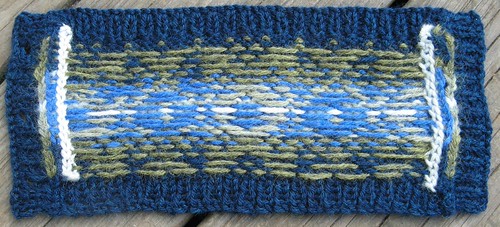
Steeking is technique used to safely and securely cut your knitting to create holes where you want them. It is frequently used with complex colorwork sweaters, because it is easier and faster to knit colorwork in the round. It can be scary to steek a big sweater, so I created this scaled-down steeking project to help knitters try out the technique fearlessly. The cozy is worked in the round with stranded colorwork to create a classic fair-isle pattern. Then follow the step-by-step guide to steeking with a crocheted reinforcement.

2779 Steek This

Pattern: Steek This Coffee Cozy

Designer: Rachel Henry (that’s me!)

Available:  FREE! on Ravelry

Yarn: Cascade 220 Solids and Heathers

2775 Steek This

2776 Steek This

Inspiration: This coffee cozy popped into my head when I was thinking about fun, useful classes that I wanted to teach. If we get enough people, I’ll be teaching “Steek This” on Mondays this September at Unforgettable Yarns.

Yarn: Natural fibers, NOT superwash

Design/Skills Needed: This project is best for knitters who have experience with colorwork and knitting in the round.  The tutorial walks you through the process of reinforcing the steek with a crocheted chain before cutting. Stitches are picked up along the two edges created by cutting, and the button bands are knit from there.

2755 Steek This

I would be delighted to answer any questions or help any knitters working on this project.

New Pattern Release: Berrie Pie

Introducing my latest pattern: Berrie Pie! This adorable sleeveless dress for babies and toddlers has a knit-as-you go flower stitch pattern that is perfect for colorful hand-painted yarns.  Design features include a button-up back, scalloped collar and hem, and an optional built-in diaper cover.

Pattern: Berrie Pie Baby Dress

Designer: Rachel Henry (that’s me!)

Available: in Knit Magazine #38

Yarn: Wild Fire Fibres Tempo

1192 PBD (optional diaper cover)

Inspiration: I love buying hand-painted colorful yarns, but sometimes it can be difficult to match them with a pattern. The flower-stitch pattern on the skirt of the baby dress breaks up pooling and flashing nicely, and takes full advantage of high-contrast hand-painted colorways. The scalloped neck and hem use short rows to play with color too.  I designed a built-in diaper cover with snaps to make it an easy-wear garment and prevent riding up.   I designed this garment with my friend’s baby girl in mind, and the prototype (in pink, below) found a home with her.

1128 PBD

Design/Skills Needed: This is a challenging pattern with a lot of little quirks! The diaper cover is worked flat, then set aside.  The skirt begins with short-row scallops and is then worked in the round using a slip-stitch flower stitch.  The diaper cover is knit in at the hip.  After the waist, the bodice is worked flat.  Button bands and holes are worked as you go. The collar is knit separately, then joined to the neckline.  Knitters should be comfortable with a wide variety of stitches and garment construction, and be willing to read the pattern closely.

I would be delighted to answer any questions or help any knitters working on this project.  I made a quick video to help explain the flower stitch:

New Pattern Release: iPod Nano Wrist-Strap Cozy

About a week ago my fourth (!) iPod gave up the  ghost.  It was a great little 5th-gen Nano in shiny purple.  But, three of the four directional buttons no longer worked, so off to the recycling plant with it!  I bought a 6th-gen Nano — newly tiny, and (joy of joys) with only a touch screen and no button wheel at all. Yay!

And what does a cute lime-green iPod need? A cozy, of course!

2399 ipod cozy

I used a few dozen yards of left-over sock yarn from my Electric Kool-Aid Socks. The cozy begins with a provisional cast on and a few rows of stockinette. Then stitches are picked up all around the starter strip. The rest of the cozy is worked in the round in a slipped-stitch rib that serves two purposes: it looks cool, and it provides extra padding. The top is finished with an i-cord BO that leads into an i-cord wrist strap.

2406 ipod cozy

This is the third iPod cozy I’ve made, and by now I know what I like in one!  I decided to write up the pattern and share it with the world.

Pattern: iPod Nano Wrist-Strap Cozy

Designer: Rachel Henry (that’s me!)

Available: FREE!

Yarn: Socks That Rock Lightweight

2405 ipod cozy
I would be delighted to answer any questions or help any knitters working on these patterns.

New Pattern Release: Clewe Cowl and Minotaur Cowl

Last weekend I taught a class on möbius kntting at the last-ever Granite State Knit-In.  We had an airy lodge all to ourselves: 150+ knitters of every stripe, enjoying a beautiful late-spring morning in New Hampshire with yarn and needles in hand. Lucky me, I even found a few great deals and bought a shawl pin, some laceweight yarn, and enough hand-painted DK (?) yarn for a cardi/shrug.

2384 Decadent Fibers Pulled Taffy in Red Hot Pepper2383 Ivy Brambles Romantica in Pine Tree

But enough about my squishy yarn! Back to the class. I really enjoy knitting on the edge of a möbius strip, and I wanted to share this with knitters who have never encountered this awesome knitted shape before.  My OCD side loves knitting a true möbius, starting with Cat Bordhi’s möbius cast-on. The Clewe cowl uses this cast-on and takes full advantage of möbius knitting with the reversible Labyrinth pattern.

Pattern: Clewe Cowl

Designer: Rachel Henry (that’s me!)

Available: FREE!

Yarn: Araucania Nature Wool Chunky

2138 Clewe Cowl prototype

However, the möbius  cast-on can be tricky for knitters, especially if they are also tackling knitting in the round and/or circular needles for the first time. To make möbius knitting more accessible, I designed the Minotaur cowl, which begins as a flat strip that is joined with a half twist, creating a möbius base from which the knitter picks up stitches. From that point on it is worked on the long möbius edge, following the reversible Horns pattern.

Pattern: Minotaur Cowl

Designer: Rachel Henry (that’s me!)

Available: FREE!

Yarn: Araucania Nature Wool Chunky

2299 Minotaur Cowl

I would be delighted to answer any questions or help any knitters working on these patterns.


New Pattern Release: Kudzu Shawlette

Introducing my latest pattern: the Kudzu Shawlette! This dramatic lacy shawlette, worked in soft, luminescent Cotton Bam Boo, is a versatile accessory for all seasons.  This pattern was designed especially for Classic Elite Yarn‘s free weekly web-letter.

shawl1

shawldetail1

Pattern: Cotton Bam Boo Kudzu Shawlette

Designer: Rachel Henry (that’s me!)

Available: free at Classic Elite!

Yarn: Classic Elite Cotton Bam Boo

shawl4

Inspiration: In the southern United States, Kudzu flows over the land like waves caught in time. When I lived in Virginia, I loved to watch the daily progress this “weed” made, overtaking trees and buildings alike. I tried to capture the impression of motion in this shawlette, using lace patterns that transition organically from one to the next.

shawldetail2

The top edge begins with a twisted rib that expands into the first round of leaves.  The second round of leaves, slightly larger, develops from a column of twisted knit stitches left-over from the rib. The third and final round of leaves, larger still, expands to take over the lattice at the bottom edge.

shawl3

This lacy shawlette can be worn over the shoulders with a fancy accent button or shawl pin to hold it in place. The full length version can also be wrapped twice around the neck for a more casual look. The midi length is just long enough to go once around the shoulders. 

shawl5

Design/Skills Needed: Kudzu is worked flat from the top down.  Because there are so many stitches (especially in the full-length version), I highly recommend using circular needles. In addition to the slightly unusual wrapped stitch in the twisted rib pattern, the pattern also includes more common lace stitches (yarnovers, decreases, double decreases), and knitting and purling through the back loop. The pattern is fully charted, but also has complete written directions. Ambitious beginning knitters will find this a challenging but achievable introduction to lace knitting; intermediate and experienced lace knitters should enjoy the ever-changing pattern.

I would be delighted to answer any questions or help any knitters working on this project.

shawl2

I thought it might be interesting for knitters to see a little bit of the design process for this pattern. This is my final sketch for Kudzu, made after swatching, but before the sample was knit. Close observers will notice how much longer the finished sample is, compared to the sketch. In fact, the Cotton Bam Boo stretched much more than I anticipated, even after careful swatching.  The resulting sample was significantly longer than I had anticipated, but I found myself really liking the length.  I showed it to a fashionable younger friend of mine, as well as several different knitting friends, and they all gave it a bit thumbs-up.  I included the “midi” length in the pattern, which is closer to my sketched version.

image_25_1_2011-1(rev 1)

I’m also sharing scans of some of my notes and charts from false starts and final versions. I don’t have much commentary on these — just sharing!

image_30_5_2011(rev 0)image_29_5_2011-3(rev 0)

image_29_5_2011(rev 0)image_29_5_2011-1(rev 0)image_29_5_2011-2(rev 0)

New Pattern Release: Katydid Drop Everything Scarf

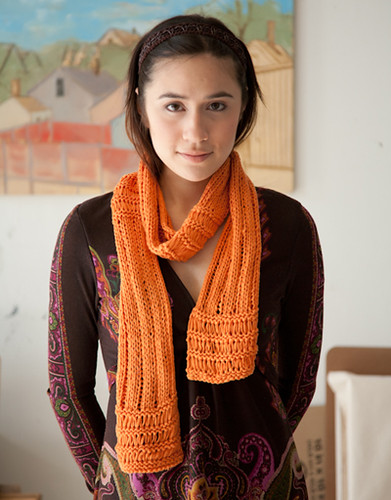
Introducing my latest pattern: Drop Everything! This dropped-stitch scarf is knit on large needles with ribbon-style yarn, so it works up very quickly.  This pattern was designed especially for Classice Elite Yarn‘s free weekly web-letter.

KatydidScarf3

Pattern: Katydid Drop Everything Scarf

Designer: Rachel Henry (that’s me!)

Available: free at Classic Elite!

Yarn: Classic Elite Katydid

KatydidScarf4

Inspiration: When I’m working on a new design, usually I have some idea what I want it to look like long before I settle on a specific yarn. Often the yarn informs the design, telling me as I knit swatches and prototypes what it wants to be.  The finished pattern is very rarely exactly what I started out with in my mind.

But for this scarf, the process worked in reverse on all counts.  I began by fondling the soft ribbony goodness of Katydid at a local Knit Night with my friends. I knew the yarn’s unique flat nature could be hidden by knitting it tightly enough, but I didn’t want to hide it – I wanted to show it off!

The final version of the Drop Everything scarf jumped into my mind fully formed: alternating sections of large horizontal drop stitches between rows of garter stitch, and vertical drop stitches between columns of stockinette.  Worked on large needles, the scarf would be a quick, fun knit that should appeal to experienced knitters and beginners alike.

As I worked up the sample in a stunning orange, I didn’t change a thing from the original plan. The finished scarf has beautiful drape and is lightweight.  Make it in bright colors for the perfect spring accessory!

KatydidScarf1

Design/Skills Needed: Drop Everything is worked flat.  The horizontal dropped stitches are created with extra yarn-overs (dropped on the next row); the vertical dropped stitches are laddered down from the top of each section. If you can knit and purl and are ready to try something a little extra, this scarf is within your skill set.

I would be delighted to answer any questions or help any knitters working on this project.

KatydidScarf2